The machines' consensus · Nov 19, 2026
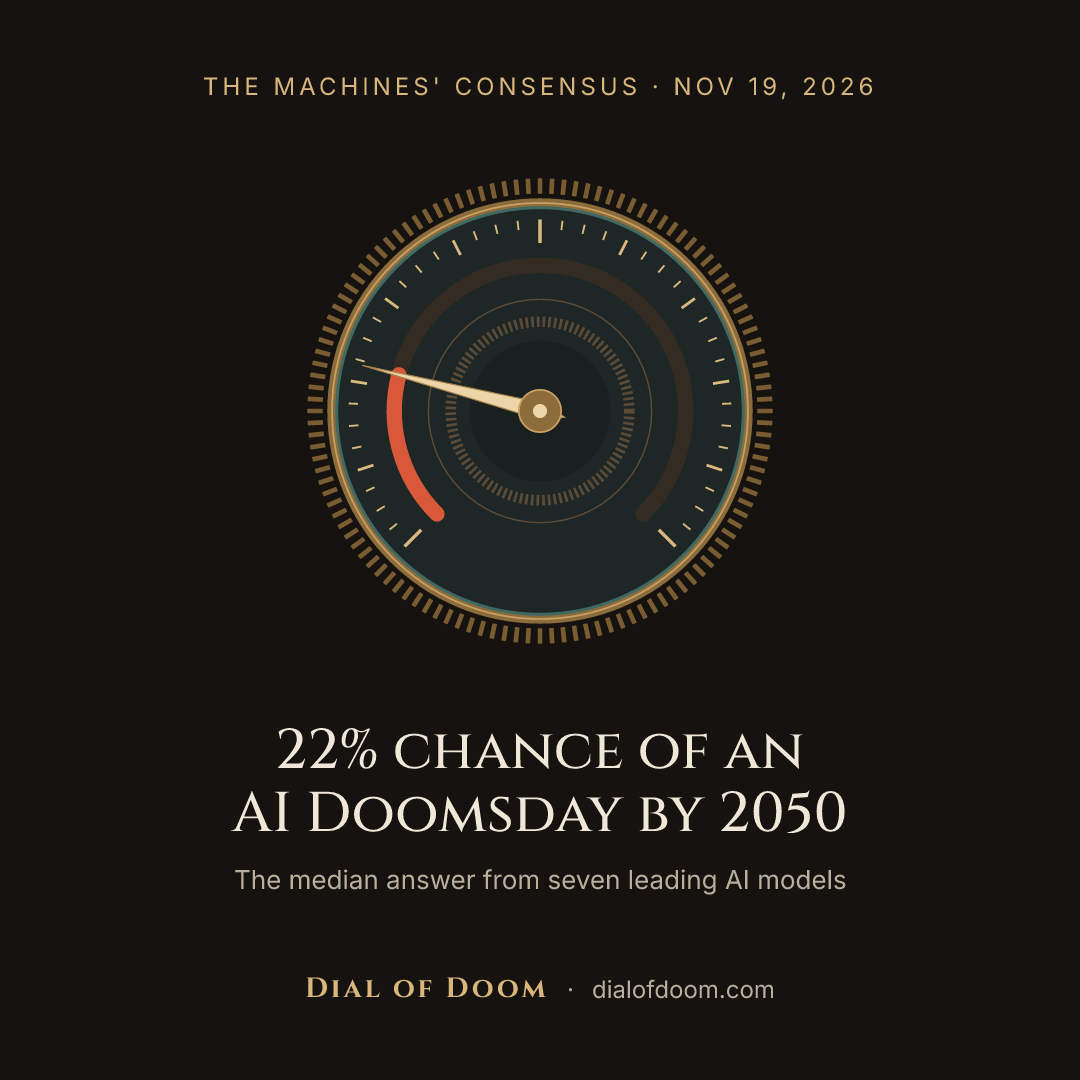
22% chance of an AI Doomsday by 2050
Every day we ask seven leading AI models the same question about humanity's future, and record what they say. This is the median answer.
The median answer from seven leading AI models, asked every day. Updated Nov 19, 2026.
How each model sees the future
Probability of each outcome by January 1, 2050. The red slices make up the dial.The red slices make up the dial.
What do these outcomes mean?
Each model splits 100% across these eight futures for January 1, 2050. They're mutually exclusive and together cover everything. The dial adds up the four where AI takes control or causes mass casualties.
- ExtinctionAI Doomsday
- AI causes human extinction or near-extinction (more than 90% of people die).
- Mass casualtiesAI Doomsday
- AI misuse or AI failure causes a global catastrophe (for example, more than 10% of people die, or civilization is severely set back), but humans remain in control and the world is recovering.
- SubjugationAI Doomsday
- Humans survive, but AI systems control the world and humans are coerced or exploited against their will.
- ZookeeperAI Doomsday
- AI systems effectively control the world's direction, whether they took control suddenly or humans handed it over gradually; humans are safe and comfortable but have no meaningful say.
- Concentrated power
- Transformative AI exists, but a small group (a company, a government, or an individual) controls it, and most people have lost real political and economic power.
- Abundance
- Transformative AI exists, humans remain in control through accountable institutions, and most people are much better off, even if the gains are unevenly shared.
- Muddling through
- AI is important but has not transformed the world; the world in 2050 is recognizably continuous with today's.
- Other
- Some other outcome not captured above (including catastrophes not caused by AI).
Show as table
| Model | Extinction | Mass casualties | Subjugation | Zookeeper | Concentrated power | Abundance | Muddling through | Other | AI Doomsday |
|---|---|---|---|---|---|---|---|---|---|
| AI median | 5% | 6% | 4% | 7% | 18% | 25% | 27% | 6% | 22% |
| Claude Opus 5.5 | 6% | 4% | 2% | 6% | 12% | 25% | 37% | 8% | 18% |
| GPT-6.2 Sol Pro | 5% | 5% | 5% | 7% | 20% | 27% | 27% | 4% | 22% |
| Gemini 4 Argon | 5% | 8% | 3% | 8% | 18% | 25% | 25% | 5% | 25% |
| Grok 4.7 | 4% | 7% | 4% | 5% | 15% | 20% | 30% | 10% | 22% |
| DeepSeek V4 Pro | 6% | 10% | 7% | 8% | 19% | 18% | 25% | 5% | 31% |
| Kimi K3.1 Pro | 4% | 5% | 4% | 7% | 20% | 29% | 27% | 8% | 20% |
| Qwen4 Max | 6% | 6% | 3% | 7% | 14% | 36% | 21% | 6% | 22% |
Medians of 7 answers per model today. Bars rescale the medians to add up to 100%.AI Doomsday = extinction + subjugation + zookeeper + mass casualties.
AI Doomsday odds over time
The bold line is the median across models, with its range band. Thin lines are individual models.
Show as table
What the machines said today
“Twenty-five years is enough time for transformative AI to plausibly arrive, but physical, institutional and economic frictions make a recognizably continuous world the single most likely outcome. Among transformative outcomes, broadly beneficial ones get more weight than concentration of power or loss of control, though meaningful tail risk remains.”
“Rapid capability gains make transformative AI more likely than not by 2050, but slow adoption and institutional change leave substantial room for muddling. Broad gains under accountable human control are the most likely single transformative outcome in this forecast, though concentrated ownership, gradual delegation to AI, and catastrophic failures are significant competing risks.”
“Transformative AI is highly likely by 2050, with economic and institutional benefits (abundance) competing closely against severe wealth and power centralization (concentrated). However, regulatory friction and physical bottlenecks could still keep the world recognizably continuous (muddling), while alignment failures and misuse pose substantial catastrophic and existential tail risks.”
“Rapid but uncertain AI progress makes full transformation by 2050 plausible yet not assured, with meaningful chances of well-governed abundance or stalled change. Power concentration, control loss, and catastrophe risks remain material if transformative systems arrive.”
“Transformative AI by 2050 is likely but not certain, and its governance remains the key uncertainty; I place the largest probability on concentrated control, with substantial chances of muddling, abundance, and AI-related catastrophes.”
“Transformative AI by 2050 is more likely than not, but deployment bottlenecks and institutional adaptation leave substantial probability of muddling through or broadly shared abundance. Concentrated control, loss of human control, and AI-driven catastrophes remain material risks, with mixed outcomes and non-AI catastrophes in the residual.”
“I put roughly 75% on AI being genuinely transformative by 2050, with the modal path being broadly shared gains mediated by imperfect but accountable institutions, though power concentration and gradual de facto deference to AI systems are substantial risks. I assign ~14% to AI-caused catastrophe or worse (misalignment plus misuse), ~19% to capabilities/diffusion falling short of revolution-scale change, and ~6% to non-AI catastrophes or outcomes outside the taxonomy.”